One room in the house is cold and nobody can figure out why. The thermostat in the hallway reads seventy, everyone in the living room is comfortable, and the back bedroom sits at sixty-two with the door shut and a space heater humming away under the window. At Riley Plumbing, Heating, and Air we have been crawling under houses in Gardnerville, Minden, Carson City, and around the Tahoe basin since 1999, and our technicians hear about that room every single November. Usually within a week of the first hard freeze. The furnace is almost never the problem, which is why replacing it rarely fixes anything. This article walks through what actually makes one room always cold, how we find the cause, and what the repair looks like once we do.
Why Is One Room Always Cold When the Furnace Runs Fine?
A furnace makes heat. Ductwork decides who gets it. Those are two different jobs, and a furnace can be running perfectly, hitting its temperature rise, cycling exactly the way it should, while one bedroom at the end of a long duct run never gets warm.
What sets a room's temperature is how many cubic feet of warm air arrive at the register every minute, measured against how fast that room loses heat through its walls, windows, and ceiling. A room at the far end of the house is fighting both ends of that equation. It sits at the end of the longest duct run, so it has the most friction working against it. And in a lot of the houses we service it also has the most exposed wall area, sometimes three outside walls and a window that was new when Clinton was in office.
So when a homeowner tells us one room is always cold, our technicians are not thinking about the furnace. We are thinking about what happens between the furnace and that register.
What We Find Under the House
Most of the homes in our book sit over crawlspaces, not slabs, and that is where the ductwork lives. So that is where we go. A complaint of one room always cold in a crawlspace home almost always traces back to something under the floor.
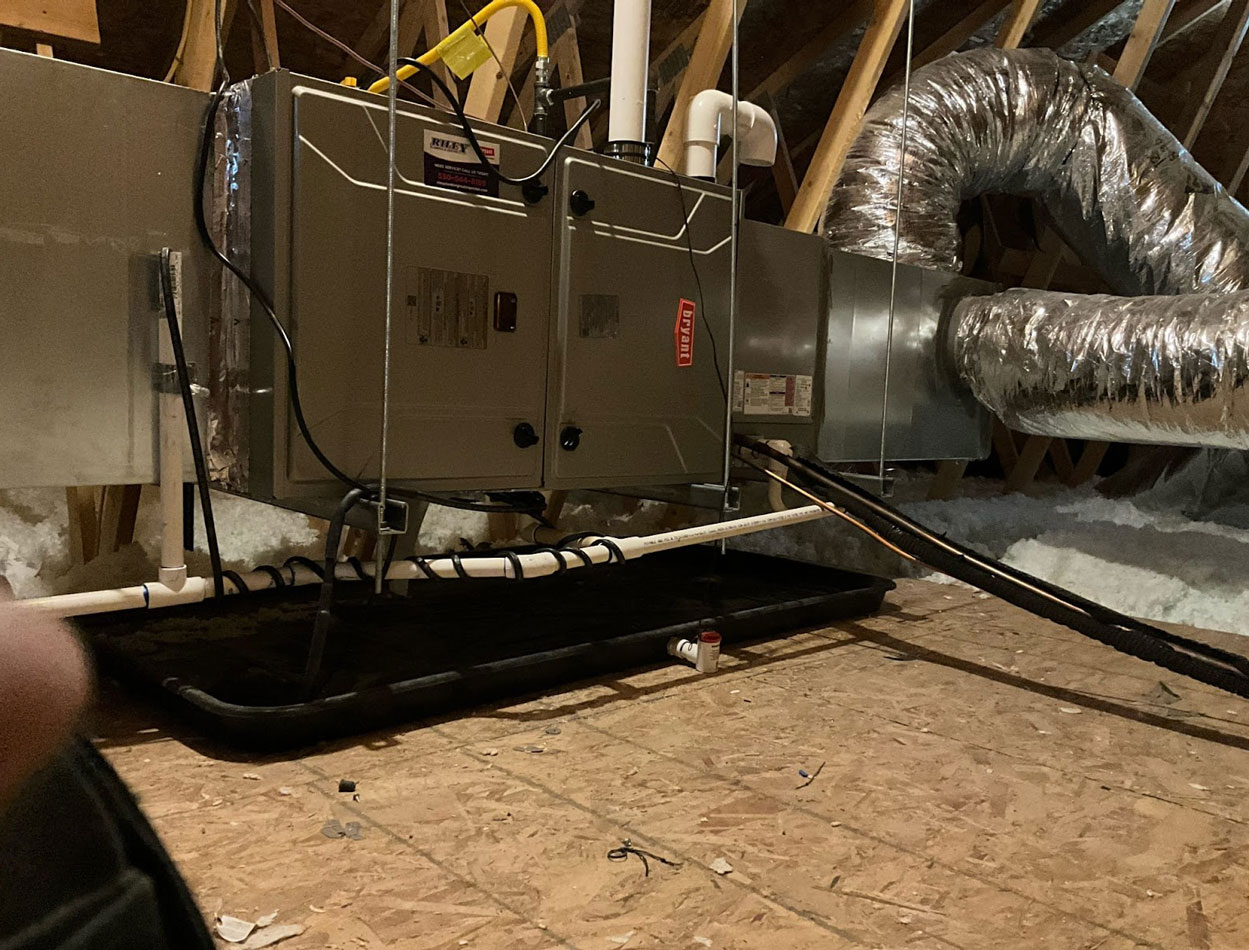
We crawl under the house and look for damaged or disconnected ducts. It sounds basic. It is also, by a wide margin, the single most common thing we find. A flex duct boot pulls loose from the register and dumps warm air into the crawlspace for three winters before anybody notices. A run gets crushed where it passes a floor joist. Another trade steps on a duct while running a cable or a water line and flattens it to half its diameter. Rodents open up the insulation and the inner liner behind it.
We also find dampers that somebody closed years ago and nobody opened. On one job we pulled a six inch damper out of a crawlspace duct run and airflow to a first floor bedroom came right back. On another we relocated a ten inch supply duct to the other side of a wall because it had been routed in a way that strangled the room it was supposed to feed. Neither of those houses needed a new furnace. They needed somebody willing to get dirty.
The Smoke Machine Tells Us What the Eye Misses
Not every duct problem is something you can see. A seam that has pulled open an eighth of an inch along the top of a trunk line looks fine from below, and it will bleed heated air into the crawlspace all winter.
That is what the smoke machine is for. We run smoke through the return air side of the system and watch where it comes out. Leaks that are invisible to a flashlight show up as a plume. It turns an argument into a fact, and it puts the repair exactly where the loss is instead of somewhere close to it.
Here is the part homeowners do not expect. Air that leaks out of a supply duct in the crawlspace has to be replaced by air pulled in from somewhere, and that somewhere is usually the crawlspace itself. Now the system is heating dirt air. Sealing those leaks does more for a cold bedroom than any thermostat ever will.
Undersized Returns and the Altitude Nobody Accounts For
A system cannot deliver more air than it can pull in. We see undersized returns constantly, and the symptom shows up first in the room that was already marginal.
One house had an eighteen inch flex return feeding a five ton system that needs twenty inches at a minimum. The furnace was starved. Every register in the house was weak, but the back bedroom was the one the homeowner noticed, because it was the one that crossed the line from barely adequate to uncomfortable. We removed the old return grille and re ducted it down to the furnace. Different house after that.
Then there is elevation. Gardnerville sits right around forty seven hundred feet and parts of the lake are over six thousand two hundred. Thinner air carries less heat per cubic foot and burns differently, which is why a furnace installed up here has to be configured for altitude rather than dropped in at factory settings. We have pulled blower assemblies to get at units that were never set up correctly in the first place. A furnace that is not derated properly for this elevation will underperform in exactly the room that has the least margin.
When Ductwork Is Not the Answer
We will tell you honestly when the ducts are fine.
Sometimes a room is cold because of the building, not the system. A bonus room over an unconditioned garage loses heat through the floor faster than any reasonable duct run can replace it. A room that was added on later and tied into the existing system with one undersized branch was shorted from the day it was framed. Single pane windows on a north wall in Indian Hills will pull heat out of a room all night long no matter what arrives at the register.
And we will not sell you zoning on a system that is already short on air. Adding a zone board and dampers to a furnace that cannot breathe does not move heat to the cold room, it just starves a different one and shortens the life of the equipment. Our technicians would rather fix the return, seal the leaks, and get the distribution right first. If the house genuinely needs zoning after that, we will say so. Usually it does not.
Call Riley Plumbing, Heating, and Air
Riley Plumbing, Heating, and Air is locally owned and operated and has served Northern Nevada and the Tahoe basin since 1999. Our technicians are factory trained, our trucks are stocked, and we answer emergency calls twenty four hours a day, seven days a week.
We serve Gardnerville, Minden, Carson City, Reno, Zephyr Cove, Indian Hills, Truckee, and South Lake Tahoe.
- Nevada: 775-293-8855
- California: 530-564-8855
- Email: service@rileypha.com
- Schedule online: rileyplumbingheatingandair.com/contact/
If you have one room always cold in your house, call us and we will find out why.
Back to Blog