
The pipes start making noise. A thump or a knock somewhere behind the wall, usually twenty minutes after somebody takes a shower, and it was not doing that last year. We took a call exactly like that last month, and what we found was the water heater expansion tank. Riley Plumbing, Heating, and Air has been plumbing houses in Gardnerville, Minden, Carson City, Reno, and around the lake since 1999, and this is one of the few components in a house that almost nobody can point to, almost everybody has, and very few people ever check. This article covers what that tank is doing up there, how it fails, how we test it, and when a house genuinely does not need one.
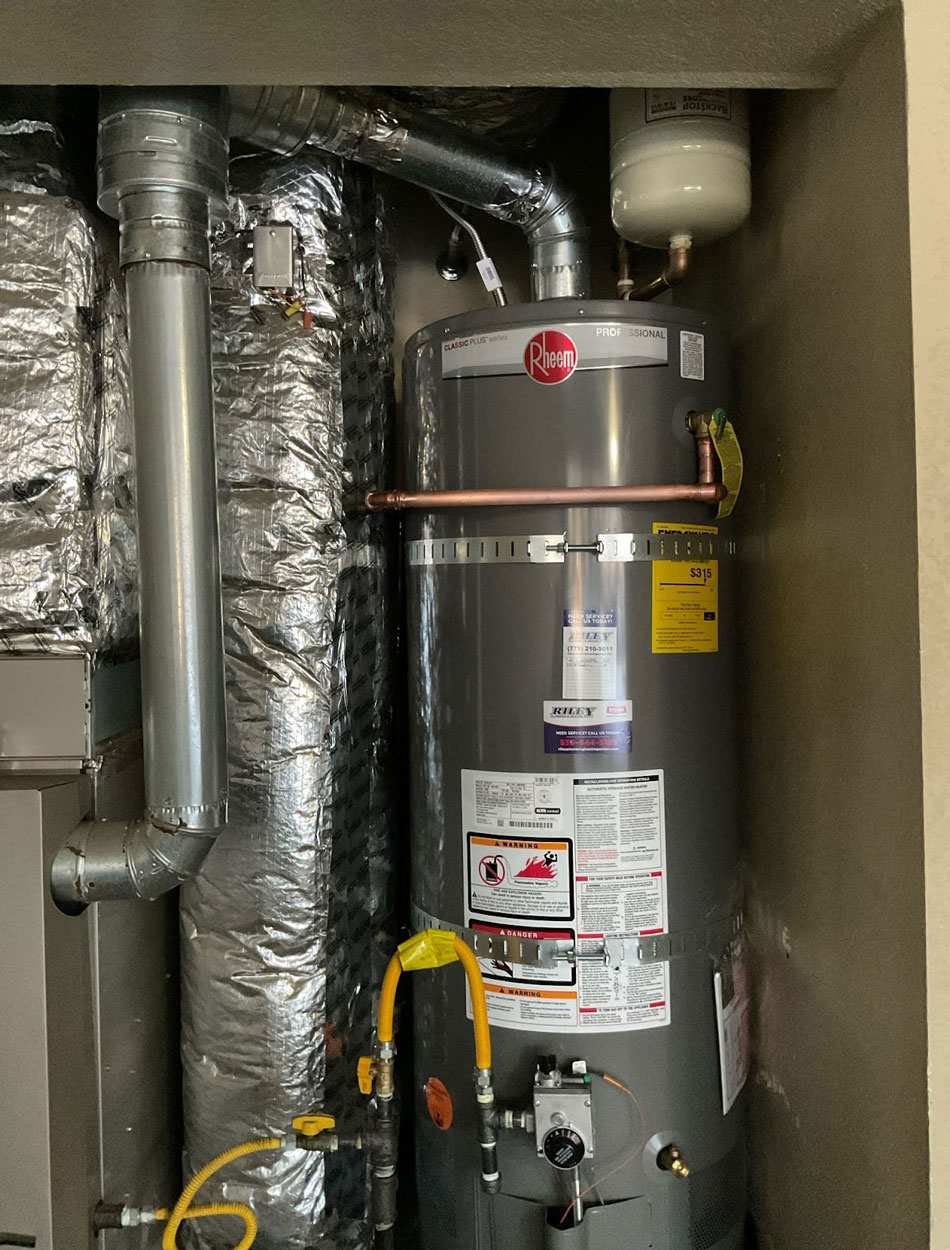
What a Water Heater Expansion Tank Actually Does
Water expands when you heat it. Not much, roughly two percent by volume going from cold inlet temperature up to a normal storage setting, but a fifty gallon tank gaining even a gallon of volume has to put that gallon somewhere. And water does not compress. You cannot squeeze it into the space it already occupies.
In an open system that extra volume simply pushes back out through the cold supply toward the street main, and nothing dramatic happens. But most houses are not open systems anymore. If there is a pressure reducing valve, a check valve, or a backflow preventer at the meter, the water in your house cannot go backward. The system is closed. Now that expanding gallon has nowhere to go, and the pressure in your plumbing climbs every time the burner or the element fires.
That is the job of the water heater expansion tank. It is a steel can with a rubber bladder inside and air pressure behind it. Expanding water pushes the bladder, the air compresses because air does compress, and the pressure spike disappears into that cushion instead of into your fixtures.
The Call That Started With a Noise
The homeowner thought they had a water hammer problem. Reasonable guess, because that is what it sounded like.
What was actually happening was pressure. With the cushion gone, every heating cycle drove system pressure up hard and fast, and the plumbing was moving against its straps and hangers as it loaded and unloaded. The noise was the symptom. The dead tank was the cause.
This is the part worth understanding. That pressure does not stay politely in the pipe you can hear. It loads every fill valve, every supply line, every cartridge and seal and soldered joint in the house, several times a day, for years. Toilets that run for no reason, faucets that drip after being rebuilt, a relief valve on the water heater that weeps and gets blamed on the water heater. A failed water heater expansion tank shows up as half a dozen unrelated looking problems before anybody connects them.
How We Tell a Dead Tank From a Live One
The first test is a knuckle. We tap the tank top to bottom. A healthy tank sounds hollow across the top where the air charge is and dull down low where the water is, and you can hear the line between them. A waterlogged tank sounds full all the way up, and when you put a hand under it, it weighs like it looks.
Then we check the air valve. There is a schrader valve on the tank, same fitting as a tire. Depress it. Air means the bladder is intact. Water means the bladder has ruptured and that tank is doing nothing but taking up space on the cold line.
The last step is the one that gets skipped most often, and it is the reason tanks fail early. The air charge in the tank has to match the static water pressure in the house. We gauge the house pressure at a hose bib, then set the tank precharge to match it with the tank isolated and drained. A tank charged at the factory default and installed on a house running a very different static pressure is not going to work the way it should, and it will not last the way it should either. Our technicians check that on every water heater we install, right alongside the seismic strapping, the drain pan, and the vent.
Signs Your Water Heater Expansion Tank Has Failed
Worth a look if you notice any of these:
- Knocking or thumping in the walls after hot water use
- The temperature and pressure relief valve on the water heater dripping or weeping
- Toilet fill valves cycling on their own with nobody in the bathroom
- Water pressure at a fixture that reads high in the evening and normal in the morning
- A short, hard burst from a faucet when you first open it, then normal flow
- A tank that feels heavy or sounds full when you tap the top of it
When Your House Does Not Need One
We will tell you honestly when a tank is not the answer.
If your house is on an open system with no pressure reducing valve, no backflow preventer, and no check valve between the meter and the water heater, thermal expansion has a path back out to the main and an expansion tank is not solving a problem you have. Adding one does not hurt anything. It also does not accomplish much, and we are not going to put one on a wall just to have put something on a wall.
The other case is the mirror image. We get called out for a weeping relief valve and find a perfectly good expansion tank and a house running static pressure well above where it should be. That is a pressure reducing valve problem, not a tank problem, and replacing the tank would have fixed it for about a week. Our technicians gauge the pressure before recommending anything, because the same symptom points at three different parts and only one of them is yours.
Call Riley Plumbing, Heating, and Air
Riley Plumbing, Heating, and Air is locally owned and operated and has served Northern Nevada and the Tahoe basin since 1999. We hold CA License #774078 and NV Licenses #85622 C-1 and #85623 C-21B, our trucks are stocked, and we answer emergency calls around the clock.
We serve Gardnerville, Minden, Carson City, Reno, Zephyr Cove, Indian Hills, and South Lake Tahoe.
- Nevada: 775-293-8855
- California: 530-564-8855
- Email: service@rileypha.com
- Schedule online: rileyplumbingheatingandair.com/contact/
If your pipes have started making noise, call us and we will find out what is behind it.
Back to Blog